One of only six residences along a private Gladwyne lane, 1320 Huntsman Lane is a quietly masterful composition—where architecture and landscape are conceived as one continuous experience, and where restraint, proportion, and craftsmanship define its character.
A painted white stone farmhouse anchors the end of a wide gravel court, the approach unfolding in glimpses. A beech lawn, enclosed by mature trees and patterned with a restrained formal garden, introduces the first of many outdoor rooms. Elsewhere, a stone wall with an arched opening leads to a more intimate enclosure and a separate structure suited for a studio, gym, or private office—each element placed with intention rather than display.
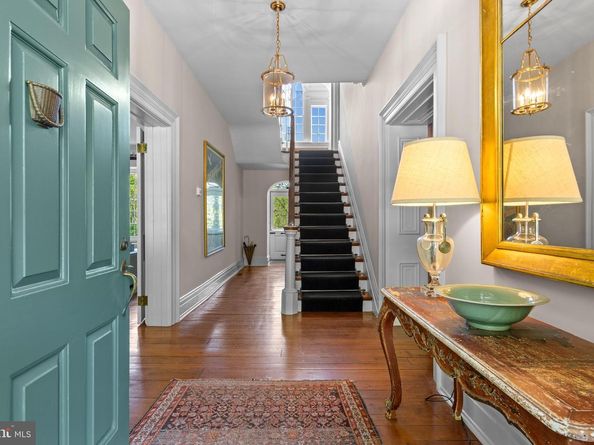
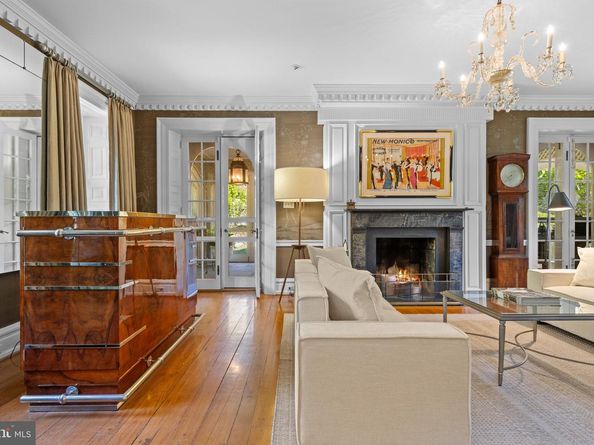
Inside, the home honors its origins while elevating them. A straight-through foyer with richly stained original floors opens to terraced gardens beyond. Principal rooms balance refinement with ease: a living room extends to a screened garden space overlooking a formal walk of towering trees and cutting gardens; a fireside library offers quiet contrast; and a dining room opens seamlessly to a bluestone terrace. A glass-wrapped solarium adapts effortlessly to daily life, always oriented toward the landscape.
The kitchen and adjoining spaces continue this dialogue. Substantial materials—wide-planked floors, marble surfaces, professional appliances—are paired with uninterrupted views outward. A glass-enclosed breakfast room opens to a wisteria-covered pergola with a fireplace, creating a space defined as much by nature as by structure. Nearby, a large family room offers a more relaxed counterpoint, with a detailed wood ceiling, wraparound windows evoking a treehouse-like setting, and a fireplace with concealed media—equally suited for gathering or retreat.
Upstairs, an arched stair window frames the symmetry of the gardens below. The primary suite is warm and composed, with thoughtfully divided baths, tailored dressing spaces, and views to the cutting gardens. Additional bedrooms are generous and well-appointed, while a private guest suite and upper-level retreat provide flexibility for extended stays. A light-filled gym, defined by exposed stone and high ceilings, completes the interior.
Here, the grounds are not ancillary; they are integral. A sequence of garden rooms unfolds along stone and brick paths that reveal rather than present. A grass tennis court, enclosed by intricate lattice fencing, is both refined and restrained, with a charming shed positioned along its center line. An allée of trees leads to the pool—rectangular, softened by a waterfall and balanced by curved seating—while two stone pavilions, seamlessly integrated, shelter dining and a waterfall-edge hot tub.
A fire pit and a discreet clock tower with bath and changing space allow days to extend fully outdoors. Specimen plantings, antique garden elements, and thoughtfully placed lighting lend a sense of permanence, while centennial brick and stone paths ground the composition.
At 1320 Huntsman Lane, beauty is not singular or immediate—it is cumulative, revealed gradually through movement, season, and time.